
Summarise this article with:
IP Geolocation Accuracy: The Real Numbers Behind IP Address Location Data
- Country level: roughly 99% accurate across every major provider. Safe to build on.
- State or region level: around 80% in the US, lower elsewhere.
- City level on fixed broadband: median error of 3 to 16 km depending on provider. Usually the right metro, often the wrong neighborhood.
- City level on mobile: median error of 179 to 207 km. That is a different city, sometimes a different state.
- Street or ZIP level: not achievable from an IP. Anything claiming it is selling you a guess.
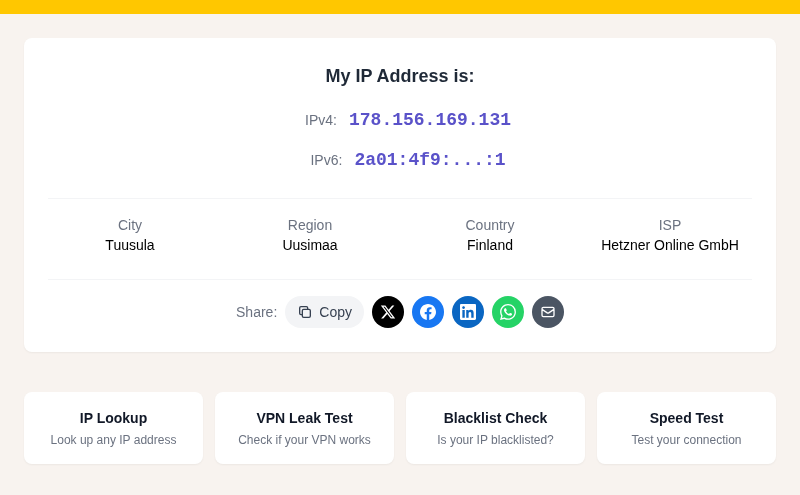
You can check what your own IP reports with the My IP Address and IP Lookup tools. If you need real precision, use device GPS through Find My Location.
I run the tools on this site, and I get the "your location is wrong" emails. Almost every one traces back to the same misunderstanding: people expect an IP address to know where they physically are, and it does not. It knows where their network connects to the internet, which is a different thing. This guide explains how IP geolocation actually works, shows the measured accuracy numbers (not the marketing ones), and tells you honestly when to rely on it and when not to.
My take in one sentence: treat IP location as a strong country signal, a decent region hint, and a coin flip for anything smaller.
How IP Geolocation Actually Works
There is a common belief that IP addresses carry location data the way a phone carries GPS. They do not. An IP address is just a number assigned to a network connection. Providers like MaxMind and IPinfo build separate databases that map blocks of IP numbers to physical places, and they assemble those maps from several sources of varying quality.
Source 1: Regional Internet Registry (RIR) data
The world's IP space is handed out by five Regional Internet Registries:
- ARIN (North America)
- RIPE NCC (Europe, Middle East, Central Asia)
- APNIC (Asia-Pacific)
- LACNIC (Latin America, Caribbean)
- AFRINIC (Africa)
When an ISP receives a block of addresses, the RIR records who got it and where they are registered. This is public through WHOIS, and you can read it yourself with the WHOIS Lookup tool. The catch is that registration location is corporate, not personal. A national ISP registered in one city may serve customers across the whole country from that single record.
Source 2: ISP and organization data
Providers buy or negotiate access to ISPs' internal allocation data, which is more granular than the RIR record. An ISP knows which city, and sometimes which exchange, a given IP range serves. The ASN Lookup tool shows the autonomous system that owns an IP, and that ownership is often the single biggest clue a database uses to guess your city. The weakness is churn: ISPs reassign ranges constantly, so this data goes stale fast.
Source 3: Active network measurements
Companies actively probe IPs to refine their guesses:
- Latency triangulation: measuring round-trip time from known servers to estimate distance.
- BGP route analysis: reading Border Gateway Protocol announcements to see how traffic reaches the IP.
- DNS LOC records: a small number of organizations publish coordinates in DNS.
Source 4: User-contributed and crowdsourced data
Some providers fold in corrections from apps that pair a GPS reading with the IP the device was using, plus website opt-ins. This is what slowly drags a database toward reality over time.
Source 5: WiFi and cell mapping
Google and Apple maintain huge databases mapping WiFi access points and cell towers to coordinates. This powers browser geolocation, not IP geolocation, but it is worth knowing the two systems are different. Browser geolocation is the accurate one.
The Real Accuracy Numbers (Measured, Not Marketed)
Most articles on this topic repeat the vendors' own accuracy claims. Those claims are real but optimistic, and they describe a "within 50km" hit rate rather than how far off the answer actually was. In 2026, researchers at Virginia Tech published "Lost in the Prefix: Revisiting IP Geolocation Accuracy Across Networks and Geographies," and they did the harder thing: they measured the median distance between the reported location and the true location, in kilometers, across the major providers. Those measured numbers are the most honest figure in this whole article.
Fixed broadband vs mobile (median error, measured)
| Provider | Fixed network median error | Mobile network median error |
|---|---|---|
| IP2Location | 3 km | 186 km |
| IPinfo | 8 km | 179 km |
| MaxMind | 13 km | 204 km |
| DB-IP | 16 km | 207 km |
Lower is more accurate. Fixed broadband, 2026 benchmarks.
_Source: "Lost in the Prefix" (Nabi, Bliton, Chung, Hasan; Virginia Tech, 2026). Median geolocation error._
On home broadband, the best providers land within a few kilometers of you; on mobile, every provider is off by roughly 180 to 210 km. The study found mobile networks carry median errors more than ten times higher than fixed networks, and traced it to mobile IP blocks spanning huge areas: around 70% of mobile prefixes cover more than 100 km of ground. If your "wrong location" experience is on a phone, this is why. There is a deeper walkthrough in Why Mobile Carrier IP Geolocation Is Often Wrong and a fixed-vs-mobile comparison in Geolocation Differences: Mobile vs Desktop.
Accuracy by precision level
| Level | Typical accuracy | Practical meaning |
|---|---|---|
| Country | ~99% (MaxMind: 99.8%) | Trustworthy. Build on it. |
| State / region | ~80% (US) | Usually right, lower outside North America and Europe |
| City | ~55-80% within 50km | Often the metro, frequently not the suburb |
| ZIP / postal code | below 50% | Do not rely on it |
| Street address | not achievable | Needs GPS, not IP |
The MaxMind figures here are their own published estimates for US addresses: 99.8% country, around 80% state, and 66% city within a 50km radius. MaxMind itself notes accuracy varies heavily by country, IP type (cellular vs broadband, IPv4 vs IPv6), and ISP practices, and that when it cannot place an IP confidently it drops the city and keeps only country and region.
Geography matters more than the vendor
The same study measured how often each provider was off by more than 100 km, broken out by continent:
| Region | Failure rate (error over 100 km) |
|---|---|
| Americas | 8-22% |
| Europe | 9-20% |
| Oceania | 43-46% |
| Asia | 53-61% |
| Africa | 66-72% |
IP geolocation that feels solid in the US or Western Europe can be wrong more than half the time in parts of Asia and Africa. If your audience is global, this disparity matters more than which vendor you pick. The cause is the same one behind the mobile problem: coarser IP blocks relative to how the network is actually announced.
Why Accuracy Varies So Much
ISP routing and points of presence
This is the biggest single factor. Your traffic does not jump straight from your house to the open internet. Your ISP carries it across their backbone, and the place it enters the wider internet, the point of presence, is the address the world sees. A rural customer can easily surface at a metro PoP a hundred kilometers away. Every database will then place that customer in the metro. You can see this on yourself: compare what My IP Address reports against where you actually are. If they disagree, routing is almost always the reason, and the full breakdown is in Why Does My IP Location Show the Wrong City?.
Mobile and CGNAT
Mobile carriers use Carrier-Grade NAT, where thousands of subscribers share a small pool of public IPs anchored at a carrier gateway. The database can only point at the gateway, which is why mobile median error runs into the hundreds of kilometers. This is not a database bug. It is how mobile networks are built.
VPNs and proxies
When someone connects through a VPN, geolocation reports the VPN server, not the user. This is now a large share of traffic: around 23% of internet users worldwide used a VPN in 2025, an estimated 1.75 billion people, roughly a third of all internet users, and adoption reaches about 42% in the United States. If a meaningful slice of your visitors run a VPN, a meaningful slice of your IP location data is the VPN's city, not theirs. You can test what a connection leaks with the DNS Leak Test and Proxy Check tools.
Database staleness
IP blocks are sold, transferred, and reassigned constantly, and databases lag. When a block moves from one region to another it can take weeks or months for the location to update. The free databases update on a monthly cadence, so a recently moved block can read wrong for a while.
IPv6
IPv6 space is enormous and many allocations are new with little historical signal, so IPv6 geolocation tends to trail IPv4. The gap is narrowing as adoption and measurement catch up.
The Major Providers, Honestly Compared
Numbers below are split into two kinds and kept separate on purpose: self-reported accuracy comes from each vendor's own site, and measured error comes from the 2026 Virginia Tech study. They are not the same thing, so do not average them together.
| Provider | Self-reported country | Measured fixed median error | Free tier (2026) | Notable |
|---|---|---|---|---|
| MaxMind GeoIP2 / GeoLite2 | 99.8% | 13 km | GeoLite2 free with account + license key + EULA | Industry default; free DB needs periodic key reconfirmation |
| IPinfo | 99%+ | 8 km | Lite: country only (city moved to paid in 2025) | Core plan $99/mo for city/region/postal |
| IP2Location | 99%+ | 3 km | LITE free (CC-BY, monthly) | Lowest measured fixed error in the study |
| DB-IP | 99%+ | 16 km | Lite free (CC-BY, monthly) | City derived from ASN + netblock, ~75-85% city |
| IPLocate | 99%+ | not in study | 1,000 requests/day free | Paid from $19/mo for 400k requests |
| IPGeolocation.io | 99%+ | not in study | 30,000 requests/month free | Paid from $9/mo for 50k requests |
A few honest notes on this table:
- IPinfo's free tier got narrower in 2025. Its free Lite product is now country-level; city, region, and postal data moved behind the Core plan at $99/month. Independent tests still put its city accuracy among the best at roughly 70-78% in North America and Western Europe.
- MaxMind GeoLite2 is free but not frictionless. Per MaxMind's own developer portal, you need a free account, a license key, and a signed end-user license agreement, the license keys require periodic reconfirmation, and the EULA requires you to update the database within 30 days of each release. It is free as in no money, not free as in no admin.
- IP2Location LITE and DB-IP Lite are both Creative Commons Attribution, updated monthly, and both run in roughly the 75-85% city band. IP2Location posted the tightest measured fixed-network error in the study.
I am not going to crown one winner, because the right pick depends on whether you need a downloadable database or an API, how global your traffic is, and your budget. For a free downloadable database, IP2Location LITE and DB-IP Lite are the easy starting points. For an API with a generous free tier, IPGeolocation.io's 30k/month is hard to beat. For maximum city accuracy and you can pay, IPinfo Core. And whatever you choose, the city-level number is a hint, not a fact.
When IP Geolocation Is Good Enough
Reasonable uses
- Country content: language, currency, and regional defaults. The 99% country accuracy carries this easily.
- Region-level analytics: understanding roughly where your audience sits.
- Country-level compliance: licensing windows, data-residency routing, geo-restrictions defined at the country line.
- Fraud signals: flagging an IP country that disagrees with a billing country, as one input among several.
- Coarse ad relevance: regional, not block-by-block.
Uses where it fails
- "Near me" results from IP alone: you will show the wrong suburb often enough to annoy people. Ask for GPS instead.
- Distance-based shipping or pricing: the error budget is too wide.
- Emergency location: never. IP geolocation is not for finding a person who needs help.
- Legal proof of location: an IP is not evidence of where a body physically was.
- Single-factor fraud blocks: do not decline a transaction on an IP mismatch alone; VPNs and routing make false positives routine.
A point of honesty about this very site: WIML's own My IP Address and IP Lookup tools read from these same commercial databases, so they inherit exactly these city-level limits. When our tool puts you in the next city over, it is not broken, it is showing you what the IP database believes. That is the whole reason the precise option exists.
How to Get Better Location Accuracy
1. Browser Geolocation API (the accurate one)
The HTML5 Geolocation API asks the user's permission and then uses GPS, WiFi positioning, or cell triangulation. Accuracy ranges from a few meters on a GPS device to around 100 meters on WiFi or cell. That is the leap from "wrong neighborhood" to "right doorstep." The Find My Location tool uses this with explicit consent, and it is the right tool whenever IP-level precision is not enough.
2. Hybrid: IP first, GPS on request
Use IP geolocation to pre-fill a reasonable country and city, then offer a "use my exact location" button that requests GPS. You respect privacy by default and gain accuracy only when the user opts in.
3. Just ask
A "what's your city or ZIP?" field is 100% accurate and fully transparent. Many products pre-fill it from IP as a convenience and let the user correct it. Boring, and the most reliable option on this list.
4. Combine signals
For fraud and risk work, no single signal is enough. Stack IP location with device timezone, browser language, GPS when available, billing address, and historical patterns. Together they describe a user far better than an IP alone ever can.
Frequently Asked Questions
How accurate is IP geolocation in 2026?
Country level is about 99% across all major providers (MaxMind reports 99.8%). City level is the weak spot: around 66% within a 50km radius for US addresses per MaxMind, and the 2026 Virginia Tech study measured a median error of 3 to 16 km on fixed broadband and 179 to 207 km on mobile networks. So it is excellent for country, decent for region, and unreliable for anything more precise, especially on mobile.
Why does my IP address show the wrong city?
Usually ISP routing. Your traffic enters the internet at your provider's point of presence, which can be a different city, so the database places you there rather than at your home. Mobile CGNAT and VPNs cause the same effect even more dramatically. Compare your reported location in My IP Address with reality, and read Why Does My IP Location Show the Wrong City? for the full chain of causes.
Can IP geolocation find my exact street address?
No. An IP maps to a network's connection point, not to a building, and street-level IP geolocation is not achievable. Any service advertising it is presenting a guess as a fact. Real street-level location requires device GPS through a tool like Find My Location, with the user's permission.
Is paying for a geolocation provider more accurate than the free databases?
At the country level there is little difference, everyone is near 99%. At the city level the paid services and the latest commercial databases tend to edge out the free monthly-updated ones, partly because they update more often. But the measured-error study found the best free download (IP2Location LITE) posted the tightest fixed-network median error. So "paid" is not automatically "more accurate"; it depends on your region, your traffic mix, and whether you need an API or a database file.
Why is mobile IP geolocation so much worse than home broadband?
Mobile carriers route many subscribers through a small set of shared public IPs anchored at carrier gateways (Carrier-Grade NAT), and mobile IP blocks cover large areas. The 2026 study found mobile median error of roughly 180 to 210 km, more than ten times the fixed-network error, with about 70% of mobile prefixes spanning over 100 km. The database can only point at the gateway, not the phone.
Does a VPN change my IP geolocation?
Yes, completely. Through a VPN, every database reports the VPN server's location, not yours. That is the point of a VPN, and it is also a major source of "wrong" geolocation across the web, since around 23% of internet users (roughly 1.75 billion people, about 42% in the US) use one. You can confirm what your connection exposes with the DNS Leak Test and Proxy Check tools.
Should I block users based on IP location?
Be careful. Country-level blocking is reasonable for compliance, because country accuracy is high. Blocking or declining at the city level, or rejecting a transaction purely on an IP mismatch, produces real false positives thanks to routing, mobile networks, and VPNs. Use IP location as one signal in a larger decision, never as the sole gate.
Is IPv6 geolocation as accurate as IPv4?
Not yet, on average. IPv6 has far more address space and many newer allocations with thinner historical data, so providers have less signal to work from. The gap is closing as IPv6 adoption grows and measurement catches up, but for now IPv4 geolocation is generally the more mature of the two.
Key Takeaways
- IP geolocation is a country-level technology with a city-level reputation it does not earn. Country accuracy is ~99%; city accuracy is roughly 55-80% and far lower on mobile.
- The honest metric is measured median error: 3 to 16 km on fixed broadband, 179 to 207 km on mobile (Virginia Tech, 2026). Lead with that, not with vendor "accuracy" claims.
- Geography is a bigger variable than the vendor. Failure rates run 8-22% in the Americas but 53-61% in Asia and 66-72% in Africa.
- ISP routing, mobile CGNAT, VPNs, and database lag are the four reasons your IP location is wrong.
- Check your own IP with My IP Address and IP Lookup; for real precision, use GPS through Find My Location.
- Never use IP geolocation for emergencies, legal proof, street-level targeting, or single-factor fraud blocks.
Related Articles:

WhatIsMyLocation Team
Our team of network engineers and web developers builds and maintains 25+ free networking and location tools used by thousands of users every month. Every article is reviewed for technical accuracy using real-world testing with our own tools.
Related Articles
Try Our Location Tools
Find your IP address, GPS coordinates, and more with our free tools.